An integral part of my teaching practise has always consisted of the Greek conception of education which is encapsulated in the term paideia, the ideal model in education according to the ancient Greeks. This timeless and universal ideal of paideia embodied in each student, is the cornerstone of the revival of Classical education.

Paideia from the Greek pais (child), paidos, paideuein ( to educate, discipline, guide, train a child). (Greek  παιδεία, paideía).Those Greek words are also related to ‘propaedeutic,’ ( providing instruction), paideutikos,pertaining to teaching and pedagogy, and paediatrics.

These educational ideals of Paideia later spread to the  Greco-Roman world and were translated as  humanitas and  equated to the ‘artes liberals’ (refer to subjects considered worthy of a free person so he or she could actively participate in civic life.) with the ‘studia humanitatis’. (studies of humanities). It was many centuries  later when this became the seven liberal arts which we know today as the trivium (grammar, dialectic or logic, and rhetoric) and the quadrivium (mathematics, geometry, music, and astronomy ).

The concept of Paideia is a fundamental principle to Greek thought and its primary element in forming ethos and culture in society. The early Greeks believed that Paideia did not only form   the building blocks of a culture, but they believed that true freedom could only be achieved through  paideia education. During that time in history  the city-state and the citizens had a reciprocal relationship both striving to achieve arete or moral excellence. The goal was to develop the mind body and heart harmoniously uniting morality  intellect and  beauty. The virtuous principles in the paideia system shaped people  in accordance with a standard  that held universal principles which did not change with time.

In conforming to the ideals of paideia  the Greeks understood that educating man into his true form, the real and genuine human nature according to Plato,  was the greatest work of all and paideia was the means of shaping human nature in accordance with the ideal. Pedagogy involved gymnastics, grammar, rhetoric, poetry, music, mathematics, geography, natural history, astronomy and the physical sciences, history of society and ethics, and philosophy—the complete pedagogical course of study necessary to produce a well-rounded, fully educated citizen.”—Richard Tarnas, The Passion of the Western Mind, pp. 29-30.

Paideia was instrumental in  perpetuating ethos and culture from one generation to the next living virtuously in accordance with our rational human nature. According to Aristotle, eudaimonia  or human flourishing was achieved through living virtuously with our human nature as rational  human beings striving to express our full potential.

Thus education according to Werner Jaeger a classicist,  paideia is ‘the process of educating man into his true form, the real and genuine human nature.” Werner Jaeger: Paideia: The ideals of Greek culture Vol. I: Archaic Greece, the mind of Athens, p. XXIII, third edition, Oxford 1946).

A response to the ideals of paideia in the twentieth century is evident in Mortimer J Adler’s revised classical education model which advocates for the Great books as seen in the Paideia Proposal. Adler believed that cultivating virtue and appreciating truth, goodness and beauty nourished the soul therefore this should be the priority of education.

Paideia, the formation and shaping of the character, aims to achieve moral virtue and intellectual wisdom by cultivating and  nourishing  the ‘true’ nature of the whole person.
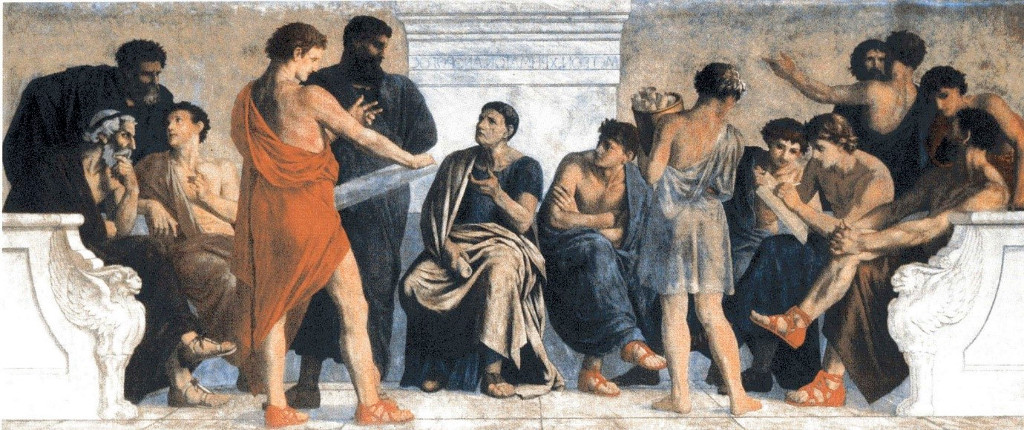
The School of Aristotle, by Gustav Adolph Spangenberg (1880)

Paideia: The Ideals of Greek Culture, Volume I: Archaic Greece: The Mind of Athens by Werner Wilhelm Jaeger, Gilbert Highet (Translator)

The Paideia Proposal: An Educational Manifesto.by Mortimer J. Adler. Macmillan.

The Passion of the Western Mind: Understanding the Ideas That Have Shaped Our World View: Author: Richard Tarnas: Edition: reprint: Publisher: Ballantine, 1993:
Research Studies on Classical Education

For those who have had the privilege of a classical education or are in some way involved in teaching or learning about it, there's little need for outside evidence to convict us of the efficacy of this pedagogy and the multiform curricula associated with it. We are very aware of the great blessings it provides, maturing young people in virtue, responsible citizenship, academic and sporting abilities, and their relationship with God and His Creation. Nevertheless, it is heartening to know that there have been several professional research studies conducted into classical schools and the results of these are undeniably positive; in fact, rather enviable for most mainstream educational institutions.

Read more ...

“The Good Teacher” – Reflections on Quintilian

In an era when students sought out educators rather than being assigned them like numbers in a lottery, finding a good teacher was of paramount importance. This was certainly true in Ancient Rome, where the association a young man (and his family) established with a teacher would not only shape his education but social networks and reputation too. Likewise, a capable, reputable teacher could build a sufficient coterie of pupils – and, if really successful, his own school – to earn an enviable livelihood.

As the classical movement grows in Australia, one of its remarkable characteristics is the manifold forms in which liberal arts education is taking place. The top-down approach is yet to bear any fruit; instead, we witness bourgeoning parent-led school communities and homeschooling efforts. One small-scale but comparatively simple and efficient model is the tutoring school, such as The Classical School in Mount Lawley, Western Australia (https://www.theclassicalschool.com.au/), where, as in the ancient Mediterranean world, students and their parents find the teacher best suited to them. There is considerable untaped potential here for both homeschoolers and those seeking an alternative means of exposing their children to classical learning. There may even be room for building a database of classical tutors throughout Australia who could work at their local level or (less favourably) online with small groups of students.

This puts the emphasis back on the quality of the teacher’s teaching and explicitly demands attention be squarely fixed on the issue (one that commonly remains in the background of mainstream schooling): What makes a good teacher? In any rich educational marketplace, it will be such a teacher who, justly, is able to garner students. To start us upon the road for an answer to this question, we can turn to Quintilian, that famous Roman rhetorician and theorist, who provides a fairly decent outline of what constitutes a good teacher in his Institutio Oratio (c. AD 95).

Read more ...

Three Teaching Techniques to Cultivate a Classical Classroom (Part One)

This paper will concern itself with three teaching techniques for the classical classroom. These three have been selected because they are easy to learn – but difficult to master; they can implemented in all age groups from K to 12. They can be used in almost every subject area. They are high impact: high impact for the students but also high impact for the teacher, in opening one’s eyes to a different way of teaching.

But before I get into exactly what these techniques are, we will have to discuss the role of a technique in education.

Read more ...

Beacons Lighting the Way to Education Reform

Given the parlous state of Australia's education system, which sees so many students leave school morally adrift, emotionally fraught and culturally illiterate, it’s not surprising hundreds of parents and teachers around Australia are seeking alternatives. From Perth to Sydney schools committed to an education that is intellectually rigorous, morally grounded and emotionally and spiritually uplifting are being established.

While schools need to teach the basic skills, prepare students for the world of work and further study, as well teaching life skills, equally as important is introducing students to Western culture’s best validated knowledge and artistic achievements. This cultural inheritance is the lifeblood of Western societies such as Australia and it needs to be passed from one generation to the next.  This inheritance doesn’t happen by accident and, while parents have a vital role to play, it’s the duty of schools to keep it alive.

Read more ...

"In Leaps and Bounds": A Report on the Australian Liberal Arts Forum 2025

On Friday 3 October 2025, Dr Kevin Donnelly hosted the fourth annual Australian liberal arts forum, this time at the Glenelg Pier Hotel by the beach in Adelaide. The event was emceed by Simon Haines, the inaugural CEO of the Ramsay Centre, and attended by over one hundred guests (with many more on the waiting list, a vastly increased turnout from the 25 attendees at the first conference in 2022).

Read more ...

Letter Writing – Simple and Still Effective

Almost every form of distance communication today is done online. Even this article, advocating writing to newspapers and your local MPs to encourage discussion around classical education, is appearing on an online blog! (And, realistically, our letters aren’t likely to be handwritten but rather emails…)

Still, through whatever medium you do it, just do it: write letters to newspapers and MPs. Perhaps the main reason why the liberal arts do not have a greater presence in Australia’s educational landscape is because people are ignorant of it as a viable – and venerable – alternative. We need to make the public more aware, or else our movement will remain a fringe one. If major newspapers and pollies receive dozens (perhaps hundreds) of letters to this effect, they will begin to become curious and we know how dangerous a little bit of curiosity can be!

Read more ...