Blog
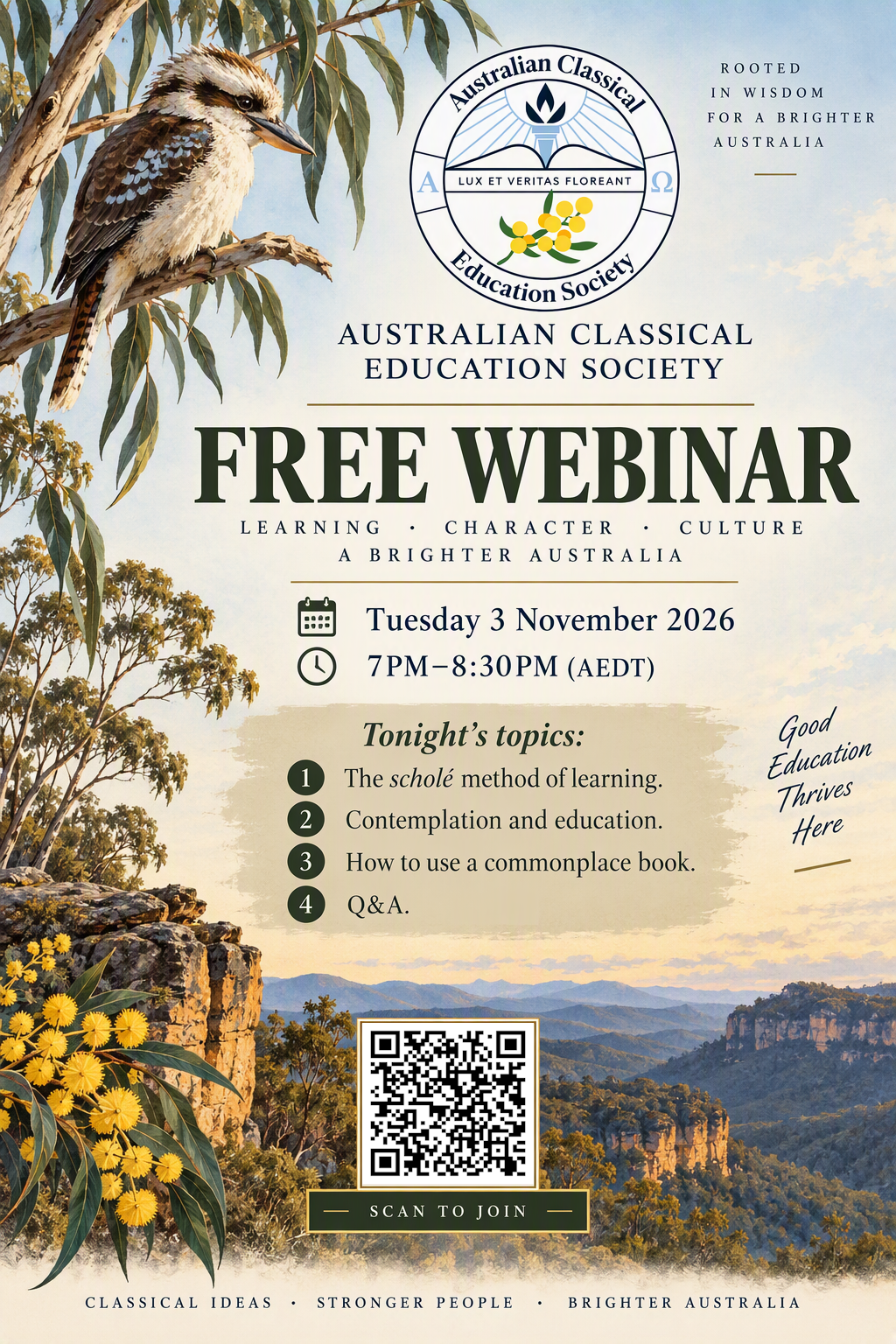
Topics include:
- The schole method of learning.
- Contemplation and education.
- How to use a commonplace book.
- Q&A.
Join us! Use the QR code to join our live Zoom session or this link.
- Written by: Jonathan Hili
For nearly ten years I have taught Euclid's Elements to twelve-year-olds. A drawer in my desk is full of colored whiteboard markers.
A student is at the board working through Proposition I.5, the one medieval students called "the bridge of asses". He has the isosceles triangle drawn. He has the two sides produced further and cut to be equal, but then he gets stuck. The proposition describes seven points, eleven lines, nine angles and five triangles all overlaid on top of one another. And the figure in front of him is a thicket of black lines that all look alike. So, I pick up the red marker and trace over a line. Then I trace another line in blue. That is enough to get him to see it. But then he goes home, opens the book, and the colour is gone.
The gap between what happened at the board and what sits on the page is what this piece is about.
- Written by: Dan Murphy
"Education is simply the soul of a society as it passes from one generation to another."
- G.K. Chesterton
Fire spreads rapidly with proper conditions but when it lacks oxygen, heat and fuel, it dissipates quickly. In the last century, the long flame of classical education was nearly extinguished. It was seemingly on its last ember and dampened by frost and lack of energy; however, the fire has been rekindled, and the flame has been growing and spreading across the American landscape among homeschooling families, in private schools, and in charter schools. It continues to gain energy, rapidly. Alleluia!
As the title of this essay suggests, I aim to share some ideas about the fundamentals of classical education and to delve into an important question for our time: Who can provide such an education to today's children? However, before jumping into the heart of classical education, I will start by offering some definitions and then say a little something about the origins, decline and revival of classical education in our day.
- Written by: Jason Caros
In a July 3, 1776, letter to his wife Abigail, John Adams voiced his hope for future celebrations of the Declaration of Independence and the birth of their nation: “I am apt to believe that it will be celebrated, by succeeding Generations, as the great anniversary Festival. It ought to be commemorated, as the Day of Deliverance by solemn Acts of Devotion to God Almighty. It ought to be solemnised with Pomp and Parade, with Shows, Games, Sports, Guns, Bells, Bonfires and Illuminations from one End of this Continent to the other from this Time forward forever more.”
Adams closed his letter soberly, for he knew the cost of American freedom would be great: “You will think me transported with Enthusiasm but I am not. I am well aware of the Toil and Blood and Treasure, that it will cost Us to maintain this Declaration, and support and defend these States. Yet through all the Gloom I can see the Rays of ravishing Light and Glory. I can see that the End is more than worth all the Means. And that Posterity will triumph in that Day’s Transaction, even if We should rue it, which I trust in God We shall not.”
Adams was prescient.
- Written by: Andrew J. Zwerneman
The spectacular rise of Artificial Intelligence (AI) has been ardently welcomed as well as anxiously feared.
In so many fields, including education, there are hopes that AI will vastly extend human capacity and the range of understanding. The power of Large Language Models (LLMs) to capture and summarise existing knowledge may provide a platform for finding new solutions to long-standing problems, and extend freedom for all kinds of creative breakthroughs in the arts and sciences. But there are also worries that AI could replace human intelligence in many areas, resulting in job dislocations and depersonalised services as well as academic cheating and bogus qualifications. The energy demands of the new data centres needed to power AI are also likely to have major social and political repercussions.
- Written by: Karl Schmude
Fifty years ago anyone hearing the term "classical education" would take it to mean the rigorous study of the most important Greek and Latin authors - poets, dramatists, historians and philosophers - in their original languages. Traditional school curricula long focused closely on those studies. Until well into the nineteenth century the sciences and mathematics were comparative neglected, and (amazingly) English was not regarded as a proper subject for study at all! There could be no better evidence of the prevalence of this kind of education than the unofficial name given to the most prestigious degree at Oxford - Greats! The very word speaks of a world which specially revered the achievements of the great thinkers and writers of past ages almost above all else.
- Written by: David Daintree
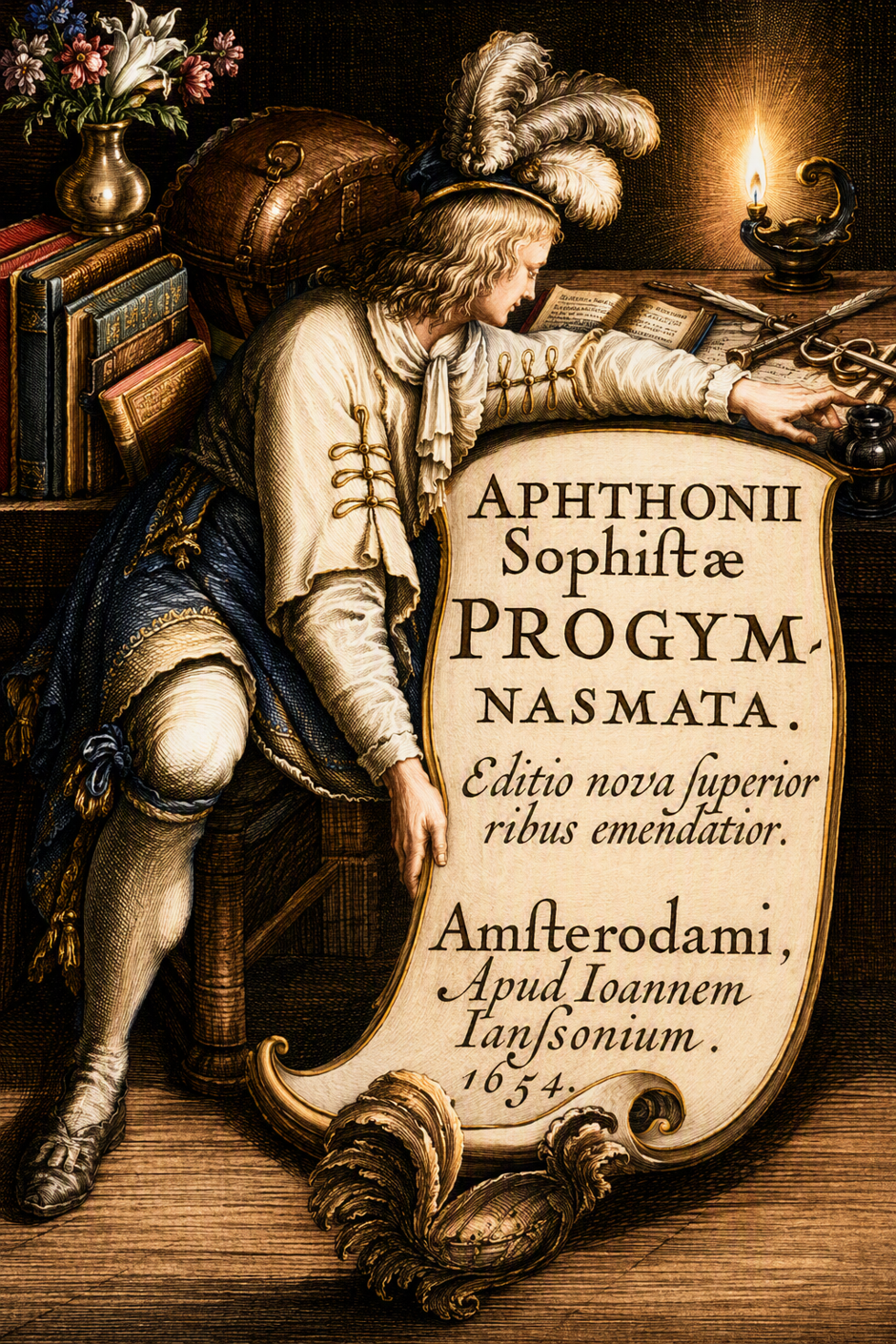 It’s common today to equate rhetoric with the ability to sustain a coherent oral argument. Within contemporary education, particularly as part of higher education certificates, students are routinely expected to articulate and defend a position on a given topic through reasoned and persuasive discourse and, to varying degrees, they are schooled in the techniques necessary to accomplish this task. Yet, such a conception of rhetoric is certainly too simplistic.
For much of Western intellectual history, rhetoric has occupied a far more significant place within a standard education. As the culminating stage of the Trivium, it represented not merely the art of public speaking but the integration of a student’s disciplined thought, moral formation and linguistic mastery, demonstrated through their clear and precise reasoning, critical judgement and sensitivity to audience and context. Of course, these skills were not isolated but embedded within a broader understanding of virtue, civic responsibility and inherited culture.
Modern education tends to underestimate the breadth and sophistication of the classical approach to rhetoric, and it is doubtful whether many secondary school or university graduates could be truly described as accomplished orators in the traditional sense. However, if our goal as educators is to foster the full intellectual, moral and social development of young people, there is much to recommend revisiting one of the most enduring pedagogical practices of antiquity: the progymnasmata.
- Written by: Jonathan Hili
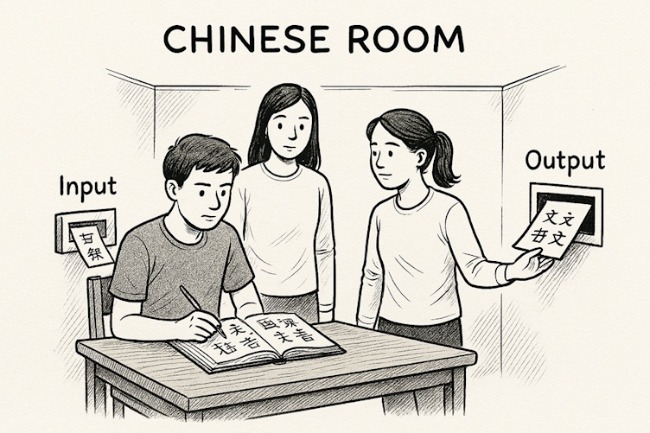
In a 1980 article titled “Minds, Brains and Programs”, the American philosopher John Searle engaged with the question of whether “strong” artificial intelligence is possible, that is, could computers become truly sentient, conscious and rationally thinking creatures? In tackling this idea, he provided an illustrative thought experiment: “the Chinese room”.
- Written by: Jonathan Hili
With the growing interest in classical education in Australia, amongst educators and parents, it is only fitting to revisit Mortimer Adler’s seminal work, The Paideia Proposal. Published in 1982, The Paideia Proposal is Adler’s educational manifesto as a solution to America's education system. While referring to the American educational landscape, Adler’s proposal can help to serve the Australian context.
- Written by: Monica Keo
…the culture of Europe has deteriorated visibly within the memory of many who are by no means the oldest among us. And we know, that whether education can foster and improve culture or not, it can surely adulterate and degrade it. For there is no doubt that in our headlong rush to educate everybody, we are lowering our standards, and more and more abandoning the study of those subjects by which the essentials of our culture – of that part of it which is transmissible by education – are transmitted; destroying our ancient edifices to make ready the ground upon which the barbarian nomads of the future will encamp in their mechanised caravans.
In his 1949 book Notes Towards a Definition of Culture, T.S. Eliot argued for a view of culture challenged by many and multifarious voices in post-Second World War Britain. His perspective defending a culture that grew organically from the interplay between the Christian religion and social hierarchy rubbed against the egalitarian, secular voices resounding from Whitehall. While the entire work is a fascinating read that causes one to reminisce somewhat on a bygone era, the main concern of this piece is to reflect on what Eliot has to say regarding education, which comes primarily from the final chapter: “Notes on Education and Culture.”
- Written by: Jonathan Hili
This paper will concern itself with three teaching techniques for the classical classroom. These three have been selected because they are easy to learn – but difficult to master; they can implemented in all age groups from K to 12. They can be used in almost every subject area. They are high impact: high impact for the students but also high impact for the teacher, in opening one’s eyes to a different way of teaching.
This entry is Part Three of a three-part article. Visit these links for Part One and Part Two.
- Written by: Conor Ross
This paper will concern itself with three teaching techniques for the classical classroom. These three have been selected because they are easy to learn – but difficult to master; they can implemented in all age groups from K to 12. They can be used in almost every subject area. They are high impact: high impact for the students but also high impact for the teacher, in opening one’s eyes to a different way of teaching.
This entry is Part Two of a three-part article. For Part One, visit this page.
- Written by: Conor Ross
For those who have had the privilege of a classical education or are in some way involved in teaching or learning about it, there's little need for outside evidence to convict us of the efficacy of this pedagogy and the multiform curricula associated with it. We are very aware of the great blessings it provides, maturing young people in virtue, responsible citizenship, academic and sporting abilities, and their relationship with God and His Creation. Nevertheless, it is heartening to know that there have been several professional research studies conducted into classical schools and the results of these are undeniably positive; in fact, rather enviable for most mainstream educational institutions.
- Written by: Jonathan Hili
In an era when students sought out educators rather than being assigned them like numbers in a lottery, finding a good teacher was of paramount importance. This was certainly true in Ancient Rome, where the association a young man (and his family) established with a teacher would not only shape his education but social networks and reputation too. Likewise, a capable, reputable teacher could build a sufficient coterie of pupils – and, if really successful, his own school – to earn an enviable livelihood.
As the classical movement grows in Australia, one of its remarkable characteristics is the manifold forms in which liberal arts education is taking place. The top-down approach is yet to bear any fruit; instead, we witness bourgeoning parent-led school communities and homeschooling efforts. One small-scale but comparatively simple and efficient model is the tutoring school, such as The Classical School in Mount Lawley, Western Australia (https://www.theclassicalschool.com.au/), where, as in the ancient Mediterranean world, students and their parents find the teacher best suited to them. There is considerable untaped potential here for both homeschoolers and those seeking an alternative means of exposing their children to classical learning. There may even be room for building a database of classical tutors throughout Australia who could work at their local level or (less favourably) online with small groups of students.
This puts the emphasis back on the quality of the teacher’s teaching and explicitly demands attention be squarely fixed on the issue (one that commonly remains in the background of mainstream schooling): What makes a good teacher? In any rich educational marketplace, it will be such a teacher who, justly, is able to garner students. To start us upon the road for an answer to this question, we can turn to Quintilian, that famous Roman rhetorician and theorist, who provides a fairly decent outline of what constitutes a good teacher in his Institutio Oratio (c. AD 95).
- Written by: Jonathan Hili